


Lambda Sensor Deletion, Non-Lambda Software and Chip Tunes for BMW

Every single client of mine, when I diagnose a faulty lambda sensor and the need for its replacement, asks about non-lambda tunes. "I've heard the car starts accelerating better and guzzles less fuel." However, they're usually not talking about an original BMW non-lambda software, nor a custom dyno tune by a specialist in the field. They mean those dime-a-dozen tuning chips sold by garage tuning masters.
BMW employs a huge team of brilliant engineers. They are orders of magnitude smarter than any garage "specialist." They achieved a compromise in their engines between power, fuel consumption, and longevity. They care about the future, hence they comply with EURO environmental standards. BMWs with petrol engines, and later diesel, are equipped with a lambda sensor, a catalytic converter, and an EVAP system that burns fuel tank vapors instead of releasing them into the atmosphere. These expensive components affect the final price of the car but allow our children to breathe without gas masks.
However, in the 90s, there were countries with less stringent automotive emission norms. For example, the Persian Gulf countries, option code L822A. There, you could order a BMW without a lambda sensor, without a catalytic converter, and without the EVAP system — option S199A. The price of the car was reduced by exactly the cost of these expensive components.
Let's immediately debunk a myth: "My catalytic converter is removed, so the lambda sensor is no longer needed." On one hand, the lambda sensor is needed for the efficient operation of the cat during exhaust gas neutralization. But even in the absence of a catalytic converter, the lambda sensor continues to constantly adapt the engine (the fuel mixture) to the environment, wear and tear, and minor engine malfunctions. Why would you remove the engine's own built-in gas analyzer?
It's also worth noting that almost every DME ECU software (except for Siemens MS40.0) with a lambda sensor has a non-lambda operational mode. First, read this article. That is, to switch the engine to a non-lambda mode, it's enough to disconnect the sensor's plug (simulating a lambda sensor fault). A fully functional engine will not run worse because of this; it's healthy and doesn't need fuel mixture corrections from the lambda sensor. If after disconnecting the lambda sensor your engine runs like crap — then it is crap and has long belonged in the scrapyard, and the lambda sensor was just barely keeping it alive.
So why do you need a non-lambda tune if you can just unplug it?
First, read this article. Without a lambda sensor, the engine loses the ability to self-adapt to environmental changes. And any old engine has wear and tear that affects mixture formation. Without a lambda sensor, you'll have to hook the car up to a gas analyzer every six months, or maybe more often, and manually adjust the mixture correction using DIS. Without this manual adaptation, over time the engine will start running worse and worse.
A proper non-lambda tune enables only one critical functionality: the ability to save the manually set mixture correction in the DME's memory, and that's it. On standard DME software with a lambda sensor, even with the sensor unplugged, any attempt to save this correction will be rejected with an error. This is the core, fundamental difference between the two software versions.
Original Non-Lambda Software
Disabling the lambda sensor only brings the BMW owner more hassle than simply replacing the faulty sensor, even if it's not a cheap pleasure. Forget the fairy tale of: "Install a non-lambda tune and forget about the lambda sensor forever."

After coding or programming the original non-lambda software into the DME, the following is MANDATORY:
- On the engine side: cap off the fuel tank vent line.
- On the fuel tank side: vent the tank line to the atmosphere.
- Install resistor part number 13901734469 onto the plug of the fuel tank vent valve — this is the "signal" for the DME to disable the EVAP system, and it will stop altering the mixture during the tank venting process. Yes, the DME compensates for the extra fuel vapors entering the intake manifold during tank ventilation by reducing injector pulse width.
- Connect a gas analyzer to the car's exhaust pipe and adjust the engine's mixture formation based on the CO level.
Depending on the engine, the mixture correction is set and saved in the DME using DIS, or by adjusting a potentiometer (variable resistor) in the MAF housing itself.

Now the engine can run normally without a lambda sensor, but you lose the future ability to diagnose various engine faults based on oxygen sensor readings using DIS. You've deliberately blinded the system.
Non-Lambda Tunes from Garage Tuners
When people talk about a "non-lambda tune," they usually mean this method. The garage specialist positions himself as 100 times smarter than the entire BMW engineering team, so he promises: complete lambda sensor deletion, increased fuel economy, a more responsive throttle, improved acceleration, easier engine starts, and so on. An observant person will notice that this list of promises covers most potential engine problems, aiming to hook the maximum number of desperate owners.
It's the same old song as with automotive snake oil: "Pour our miracle fluid into the engine and all your car problems, and even your personal life problems, will disappear." But a person will never admit they were scammed, deceived, and spent money on useless crap. No, because then they'd be considered a loser. So they start looking for a deeper meaning and, of course, find it. That's why you can find tons of "positive" reviews: "Fuel consumption dropped, acceleration improved, starts better, I recommend it. But I certainly won't do any objective measurements, otherwise everyone will find out I'm a loser who got tricked."
These chips are so "revolutionary" that you won't even need to cap the fuel tank vent or adjust CO. Everything is supposedly pre-tuned to suit the wear and tear of ALL BMW engines AT ONCE. Ironically, the DME will constantly complain about this "super" software and beg for the original one to be restored, but the garage tuner knows better, right? He's so "brilliant" that he doesn't have the time, or more likely the competence, to fix these trivial error codes. And why bother? The customers will feel the placebo effect anyway...
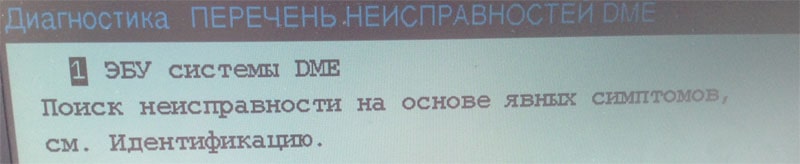

With these chips, it's impossible to save the CO correction using DIS; a DME program error will always appear. Also, these chips completely ignore the CO correction value set by the potentiometer in the MAF housing. Any form of engine adaptation to minor faults and environmental changes is absent. Stable engine operation becomes a lottery.